Something Difficult Questions On World War II


 Settings


 -
+
-
+
- 1.Short Answer: As in the First World War, Canada contributed greatly to the Allied war effort during the Second World War. By selecting appropriate examples, prove this statement correct.
- 2.
- 3.
- 4.
- 5.Essay: To what extent did World War I and World War II have a negative impact on Canada.
- 6.The Canadian liberation of Holland gave the Allies the opportunity to
- A.
Capture Dieppe
- B.
Liberate France
- C.
Bomb Germany
- D.
Continue on their way to taking Germany
- 7.
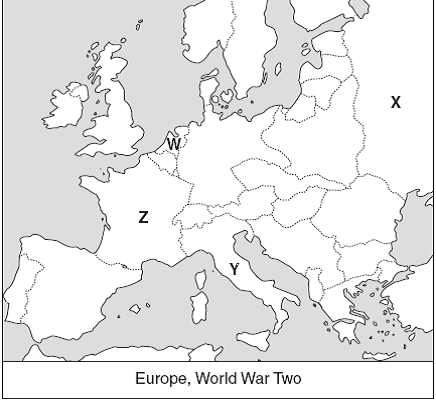
![]() In World War Two, Canadians fought battles in all of the countries except
In World War Two, Canadians fought battles in all of the countries except- A.
A. W.
- B.
B. X.
- C.
C. Y.
- D.
D. Z.
- 8.
![]() What does W on the map represent?
What does W on the map represent?- A.
A. the location of a failed invasion attempt
- B.
B. a country liberated by Canadian soldiers
- C.
C. an area extensively bombed by the Allies
- D.
D. the first battle involving Canadian soldiers
- 9.
![]()
- A.
A. Canada’s air force was much smaller than its other branches
- B.
B. Canada’s armed forces were too small to defend Canada properly
- C.
C. Canada’s coasts were defended by only one branch of the military
- D.
D. Canada’s army was prepared for war and could defend its homeland.
- 10.Which of the following required able bodied male and female workers to register for essential war work (Write in the letter followed by a period then the name of the act) A. War Measures Act B. Lend-Lease Act C. Military Voters Act D. National Resources Mobilization Act E. National Selective Services Act F. Ogdensburg Agreement
- 11.Which of the following allowed Britain to receive war goods from Canada and the US (Write in the letter followed by a period then the name of the act) A. War Measures Act B. Lend-Lease Act C. Military Voters Act D. National Resources Mobilization Act E. National Selective Services Act F. Ogdensburg Agreement
- 12.Which of the following allows government to suspend civil liberties in times of national emergency (Write in the letter followed by a period then the name of the act) A. War Measures Act B. Lend-Lease Act C. Military Voters Act D. National Resources Mobilization Act E. National Selective Services Act F. Ogdensburg Agreement
- 13.Which of the following required adult males to register for military service within Canada (Write in the letter followed by a period then the name of the act) A. War Measures Act B. Lend-Lease Act C. Military Voters Act D. National Resources Mobilization Act E. National Selective Services Act F. Ogdensburg Agreement
- 14.Which of the following was a military alliance between Canada and U.S., which established the Permanent Joint Board of Defence? (Write in the letter followed by a period then the name of the act) A. War Measures Act B. Lend-Lease Act C. Military Voters Act D. National Resources Mobilization Act E. National Selective Services Act F. Ogdensburg Agreement
- 15.When did D-Day occur?
- A.
June 5, 1944
- B.
June 6, 1944
- C.
May 8, 1945
- D.
August 12, 1945
- 16.By 1945, the Germans had murdered more than six million Jews, Roma Gypsies, Slavs, and other people considered inferior, in what became known as the
- A.
Final Solution
- B.
Holocaust
- C.
Nuremberg Plan
- D.
Jewish Solution
- 17.The Canadian involvement in the defense of Hong Kong can best be described as being a
- A.
Victory.
- B.
Draw.
- C.
Stalemate.
- D.
Disaster.
- 18.Which term describes Canada’s foreign policy during the 1930s?
- A.
Socialist
- B.
Militarist
- C.
Isolationist
- D.
Imperialist
- 19.The St. Louis incident and the many signs on factory doors, which stated “No Jews allowed” are examples
- A.
Racial intolerance
- B.
Anti-Semitism.
- C.
Civil disobedience.
- D.
Poor government practices.
- 20.With which two counties was Canada allied at the outbreak of World War II?
- A.
France and Britain
- B.
Italy and Germany
- C.
United States and France
- D.
United States and Britain
- 21.
- A.
Sicily
- B.
Ortona
- C.
Dieppe
- D.
Normandy
- 22.In 1939, why did Canada declare war on Germany one week after Great Britain?
- A.
Canadian armed forces training was incomplete.
- B.
Germany had yet to launch an attack on Great Britain.
- C.
The United States had not yet declared its position on the war.
- D.
The House of Commons had to vote on whether Canada should participate.
- 23.Which quotation is associated with the decline in voluntary enlistment in Canada during World War Two?
- A.
“You can help to win the war against fascism.”
- B.
“Conscientious objectors deserve the white feather!”
- C.
“Give us the vote of confidence, join in the campaign.”
- D.
“Not necessarily conscription, but conscription if necessary.”
- 24.Which of the following convinced the Canadian government an attack on Canada by Japan was probable?
- A.
The Japanese attack on Pearl Harbor
- B.
Evidence of Japanese spying in Canada
- C.
Japan’s military alliance with Germany
- D.
Capture of Canadians in Hong Kong by the Japanese
- 25.What WWII battle does this description match? Canadian troops surrendered on Christmas Day only to endure mistreatement in prison camps. December, 1941 a. Dieppe b. Holland c. Ortona d. Dresden e. Normandy f. Hong Kong
- 26.What WWII battle does this description match? Canadian troops fail to capture this location. August, 1942 a. Dieppe b. Holland c. Ortona d. Dresden e. Normandy f. Hong Kong
- 27.What WWII battle does this description match? Canadian troops successfully overtake this European town amid high casualties. December, 1943 a. Dieppe b. Holland c. Ortona d. Dresden e. Normandy f. Hong Kong
- 28.What WWII battle does this description match? Canadian troops assist in securing a foothold in Europe. June, 1944 a. Dieppe b. Holland c. Ortona d. Dresden e. Normandy f. Hong Kong
- 29.
![]() Use the following information to the right to answer question 19. What is the correct chronological order of these events?
Use the following information to the right to answer question 19. What is the correct chronological order of these events?- A.
1, 2, 3
- B.
1, 3, 2
- C.
2, 1, 3
- D.
2, 3, 1
- 30.The following newspaper headline reads “King returns home from overseas meeting: ‘I’m convinced his goal is world peace.” To which world leader is PM Mackenzie King referring?
- A.
Adolf Hitler
- B.
Joseph Stalin
- C.
Benito Mussolin
- D.
Kaiser Wilhelm II
- 31.Place the following WWII events in chronological order: 1. Canadians troops push Germans back across the Rhine River 2. Canadians lose an important battle in Hong Kong 3. Conscription is implemented in Canada What is the Chronological order of these World War Two events?
- A.
2, 1, 3
- B.
2, 3, 1
- C.
3, 1, 2
- D.
3, 2, 1
- 32.In which province did the majority of residents vote no in the 1942 plebiscite on conscription?
- A.
Quebec
- B.
Ontario
- C.
Saskatchewan
- D.
Newfoundland
- 33.Which group of Canadians was judged to be the greatest security risk by the federal government during WW II?
- A.
Italian-Canadians
- B.
Russian-Canadians
- C.
German-Canadians
- D.
Japanese –Canadians
- 34.Where were Japanese internment camps located?
- A.
Interior of British Columbia
- B.
Canadian Shield
- C.
Prince Edward Island
- D.
Vancouver Island
- 35.In which of the following WWII operations did Canadian forces participate?
- A.
Overlord
- B.
Barbarossa
- C.
Vimy Ridge
- D.
Passchendaele
- 36.Which of the following is an accurate statement about Canada’s role during World War Two?
- A.
Atomic research as conducted in the Prairies.
- B.
All Canadians of foreign descent were interned.
- C.
The Commonwealth Air Training Program was located in Canada.
- D.
The Canadian government did not use propaganda in the war effort.
- 37.Which statement describes Canada’s role in the Battle of Hong Kong?
- A.
Canadian troops fought a significant naval battle.
- B.
Canadian troops conducted an amphibious assault.
- C.
Canadian troops had a decisive victory in the battle
- D.
Canadian troops fought alongside Commonwealth troops in the campaign.
- 38.What was a purpose of the British Commonwealth Air Training Program?
- A.
To assist the United States Air Force in the South Pacific
- B.
To stop enemy aliens planning an overthrow of the Canadian government
- C.
To reduce fatalities overseas while maintaining Canada’s commitment to the war effort
- D.
To demonstrate Canada’s air superiority while defending against enemy attack at home
- 39.What was one reason why Canada offered to administer the British Commonwealth Air Training Plan during World War Two?
- A.
Its aircraft were the most modern in the Commonwealth.
- B.
Its pilots had gained extensive experience in World War One.
- C.
It would be reimbursed by the allies for most of the costs involved.
- D.
It wanted to minimize its direct involvement in the European conflict.
- 40.Use the following information to answer the question Veterans’ health care Free University Education Housing and land grant assistance Which group of Canadians veterans was denied access to these benefits at the end of World War II?
- A.
Canadian Army
- B.
Royal Canadian Navy
- C.
Merchant Navy
- D.
Royal Canadian Air Force
- 41.What was the result of the National Resources Mobilization Act of 1940?
- A.
It gave the vote to women.
- B.
It allowed for domestic military services.
- C.
It united English and French Canadians.
- D.
It increased industrial production in Canada.
- 42.Use the information below to answer the question …4000 landing craft headed toward the beaches…never in military history had such an attacking force been assembled! To what World War Two event does this statement refer?
- A.
D-Day
- B.
Battle of Britain
- C.
The Italian Campaign
- D.
Battle of Hong Kong


 Back to top